

As far as vices go, swigging Italian pre-dinner aperitifs doesn’t touch the behavior of Drake’s mentor Lil Wayne, who chain-smokes blunts and once consumed the promethazine-and-codeine mixture known as “syrup” daily. Drake and Lil Wayne are from different worlds – Wayne grew up in the destitute New Orleans neighborhood Hollygrove, and his music is littered with references to guns and drugs. But their music relationship is remarkably fruitful: Since first meeting in the spring of 2008, the two have collaborated over a dozen times.
After Jaz, the son of Rap-a-Lot Records CEO J. Prince, played Drake’s early music for Lil Wayne, an excitable Wayne flew him out to Houston the next day. “He was high out of his mind, getting these big wings tattooed on his body on the tour bus, for like six straight hours,” Drake told me. “And out of nowhere, everyone got on the bus and the bus started moving. I just kept my mouth shut. Rolled for like a week, ended up in Atlanta. That was the night we made our first bit of music together.” (In March, Lil Wayne reported to jail after pleading guilty to possession of a weapon. Drake has said of Wayne’s sentence: “I think that for eight months a lot of us will have to work a lot harder to keep hip-hop as exciting as it’s been for the last two years.)
Wayne’s co-sign gave Drake instant legitimacy, critically important for the tween-TV vet; in return, Drake has made Lil Wayne’s crew of hangers-on, Young Money, commercially relevant. Young Money’s “Every Girl” cracked Billboard’s top ten last summer too, mostly hanging five or six spots behind “Best I Ever Had,” and the bawdy-but-sweet verse sung by Drake did a lot to put it there.
In July, Drake became a major-label artist. Universal Motown beat out Warner Music Group and Atlantic Records in a protracted bidding war for distribution rights. (Technically, he’s signed to Lil Wayne’s imprint Young Money Entertainment.) With independent success as leverage, Drake negotiated remarkable terms for the post-file-sharing industry: all publishing rights to all his songs, 75% of his overall music sales revenues, and a $2 million advance.
Around then, the Drake obsession swung into gear: There were daily minutiae reports on MTV’s news site (Sample headline: “Drake On Dating: ‘I Like Older Women, Period'”), People gossip-mongering (no, he was not sleeping with Rihanna) and the LA Times reports on his finances. When he tore his ACL back in August, a DrakesKnee Twitter feed was created to offer personal missives, in rhyme form, from the much-scrutinized joint.
The hip-hop elite bought the hype. Kanye West offered, unsolicited, to direct the video for “Best I Ever Had” video. (The offer was accepted, and a nonsensical cleavage parade was produced.) Later, West joined Lil Wayne and Eminem on Drake’s “Forever,” a contribution to the LeBron James documentary, More Than a Game. (Oh, LeBron’s a pal too – he’s texted Drake advice on how to handle the knee rehab.) Jay-Z, during a Halloween show at Toronto’s Air Canada Centre, brought Drake out to perform; for the first time in a long while, Jay played hype-man. On Blueprint 3‘s “A Star Is Born,” Jay flat-out passes him the baton, rapping, “Drake’s up next, see what he do with it.” So how does a twenty-three-year old, formerly squeaky clean, teen soap vet deal with being heralded as the next coming of hip-hop?
Video for “Best I Ever Had,” directed by Kanye West
In person, Graham is attentive and sedate. (Polite, too — later in the night, when we switch rides to a Range Rover, he finds the remains of a cheap cigar used to roll a blunt in the car, and quickly brushes my seat clean.) This may well be him in his pre-eccentric-superstar-asshole phase, but, for now, he’s genuinely humble, if self-assured. He says cheesy things like “I have memories to last a lifetime,” but makes them sound heartfelt.
So I shouldn’t be surprised when he identifies himself, without mitigation, as a Jew, but I am – even for a typical suburban-Jew hip-hop-nerd like me, it’s hard to fathom a mainstream African-American rapper speaking publicly of observing the high holidays. To his credit, Graham is as straightforward in person as he is on record.
“I went to a Jewish school, where nobody understood what it was like to be black and Jewish,” he says. “When kids are young it’s hard for them to understand the make-up of religion and race.” He recalls being called a schvartze, repeatedly. “But the same kids that made fun of me are super proud [of me] now. And they act as if nothing happened.” He wears a diamond-studded Chai (prominently displayed on his Vibe cover) and plans, at some point after the release and promotion of his debut, to travel to Israel. He says his mother has expressed hope he’ll marry “a nice Jewish girl.” As far as public acceptance goes today, by all accounts, religion has been a complete non-issue.
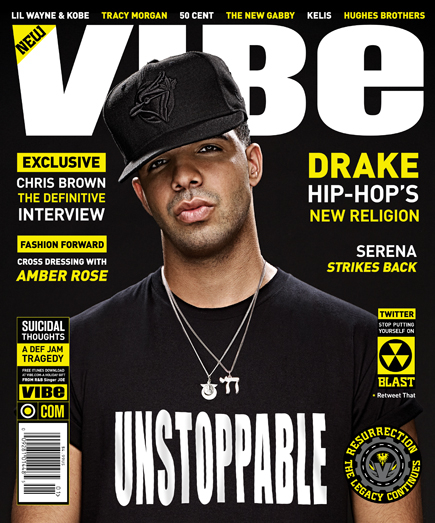
Drake’s Vibe cover. Note the Chai.
What Graham’s touchy about, though, is Degrassi. When I bring it up, personal manager Oliver jumps in. “By the last season,” Oliver measures me, “he was always late. He’d be in the studio till six, call time was at six thirty.”
“I was in so much trouble with the producers,” Graham adds, sheepishly. “I had like three and a half strikes against my name.”
For the uninitiated, the arc of Graham’s character is classic Degrassi: In season four, Jimmy Brooks goes from the basketball court to a wheelchair after being shot by a Columbine type; he eventually finds peace through painting and T-shirt design. In one episode Jimmy also raps, triumphantly, at the talent show. In Canada, he’s just as well known for acting as music. Stateside, it would be as if 90210‘s Brian Austin Green left David Silver behind to achieve real-life hip-hop legitimacy. “Degrassi was never something I saw as potentially ruining [a music career],” he says. “It was a great TV show. It had a cult following.” Last summer, during a prominent freestyle on Funkmaster Flex’s Hot 97 program, he even shouted out Degrassi High.
Degrassi‘s Jimmy Brooks never played basketball again.
Graham got the part after his first-ever audition; he was on the show for eight years, leaving in 2008, not by choice. (The producers overhauled nearly the entire cast.) At that point, his music industry experience consisted of two largely ignored mix tapes. Right before the release of So Far Gone, Graham was “teetering on getting a regular job. I was coming to terms with the fact that, okay, people know me from Degrassi, but I might have to work at a restaurant or something just to keep things going. The money from that show was very small. And it was dwindling.”
Next: the conclusion of Heeb‘s interview with Drake: “They can’t help it / and I can’t blame ’em / Since I got famous / bitch, I got money to blow.”

Love, love, love this article!!!! I’m so happy that you guys did the obligatory Drake article. And I’m so happy that Drake is a proud Jew and doesn’t shy away from pronouncing that. I really do hope he follows his mom’s desire and marries a nice Jewish girl- and I really hope that girl is me!
NO WAY! HE’S JEWISH? LOVE IT!
I’m a Black Jewish Canadian mom with a beautiful son of my own. Drake’s story is a 1-in-a-billion fairytale. If he continues to be proud of who he is, the success will always follow.
This seems like pretty much every article on Drake, I wish his Judaism would have been explored for more than just a paragraph.
You’re not black Drake, you may think you are, but you aren’t. Nothing about you is black.
Really “Wow”? You really want to debate Drake’s “Blackness”? So, what is a Black person to you? Woolly hair, big rubbery lips and an affectation? Or is it one’s ability to pop n’ lock? Ooh, ooh, maybe how well they keep their pimp-hand strong! It’s 2010 and there are still miscreants like yourself who measure and place people into their little assigned racial boxes in order to make your own miserable existence make sense. There all ranges of “being” in every race and not all of us fit the stereotypes society tosses around. We are free express ourselves and choose any identity we desire. For example, I respect your choice to be an a$$hole of the highest order. But I have to go now – the chitlins and gefilte fish won’t make themselves! Shalom Beotch!
“first-ever black Jewish rap star”- any research to back the claim? What about Y-love? Also Gavriel Butler is pretty famous in israel but I think he’s a Black Hebrew
Black and Jewish are not mutually exclusive. Never were. They have co-existed since Biblical times. I’m proud to be both, and so, it seems, is Drake. Good for him. Wish him well.
It would have been good to see the Jewish element of this story expanded. I would have wanted to know who his rav is, and why nivul peh is mutar for him.
I don’t know what’s sadder, that other JDS kids gave him shit about being black, or that they used the word “schwartze.” Really? That’s a rhetorical statement, but still.
SO WAT IF DRAKES BLACK AND JEWISH…IF U REALLY LOVED HIM U WOULD EXCEPT HIM FOR WAT HE REALLY IS AND WOULDNT CRITISIZE HIM….I GUESS THATS WAT HATERS ARE FOR RIGHT?? BUTT ANYWAYS AUBREY YOU ARE SOCUTE AND VERY SWEET I LOVE U SOO MUCH AND KEEP DOING WAT UR DOING BABE BECUHHZ I LOVE IT..XOXOX
I like to listen to drake, he is one of my favorite new male rappers today. I grew up listening to Bow Wow, Jay-Z, Naz, Will Smith, who is actually my favorite rapper of all times, but I think to me that both of them are tied to who is my favorite today. I have both cds, So Far Gone & Thank Me Later, which I gotta know why isnt Trey Songz on that Cd, Drake? I just want to know because I like to listen to the both of you on a track, just wondering. Anyway, just letting you know that I am a fan and I know that your carrer is going much highter!
drake is not the first black and jewish hip hop star. stop exoticizing us. time to get this jewish diversity thing right, HEEB
“exoticizing”…really?
Time to get this “English” thing right, La Kahena :P
He’s the first hot black, Jewish hip hop star :P
[…] his parents separated when he was younger, Drake was raised in a Jewish household. Drake was born to an African-American father and a Jewish mother, who divorced when he was five. […]
[…] Today, he wears a diamond-studded Chai, a symbol of the Jewish word for life, and has his mother pressuring him to marry "a nice Jewish girl," according to Heeb magazine. […]
[…] Today, he wears a diamond-studded Chai, a symbol of the Jewish word for life, and has his mother pressuring him to marry “a nice Jewish girl,” according to Heeb magazine. […]
Two paragraphs in, a reference to rims on a Bentley. Chris Rock would definitely say he’s Black enough, Wow.
[…] in this video, “I’m On One,” didn’t actually have to drink the product. Drake is Jewish, so he’s probably used to it, but as for Dj Khaled, a Palestinian, this is yet another abuse […]
Ummmm, Bizzy Bone was very hot when BOne-Thugs N Harmony was big and I’m sure there are other rappers with Black/Jewish heritage. Many Jews dig chocolate;-)
Lol really? I’m a little late but I’m gonna jump on it anyway. This non-fictional story / interview only bring out comments on his race? Ah! I hate that word. But in truth was is race? I’ll tell you… there is no race. We are all different yet the same. I myself am classified as a black female. But really there is nothing that a white girl has that I don’t and visversa… it depends on how dominant your genes are. Up close we are all the same color. Brown. Some more brown than others. We all have the same color blood. Depending on gender we all have the same anotomy and physiology. I’m tired of “race” impacting on how people think. As for the jewish part… I don’t want to touch that. All I know is that they too went through hell in the past and today as well. I have never spent time with a jew and knew they were a jew. But I do respect them. I respect all. I don’t believe anyone is above nor below me. Can we drop it at that. Let’s acknowledge Drake for being a true artist with words. He is a great rapper and singer with an amazing mind and I’m so proud of him for showing the world who he is…. A man with a passion.
[…] Drake gets his Jew* on with this video of the song “Headlines”. I love the song but the video is just […]
Moses married a black woman. Whats the big deal about being black and jewish? Been going on since the ancient world mixing of cultures in the African/Middle eastern region. I suggest you folks read the book RESCUE OF JERUSALEM. Brilliantly tells the tale of how Kush/Egyptians saved Israel from annihilation. Blacks kings saved the jews. Jewish rapper saving black music…
[…] epigraph of Drake’s new music video for the song “HYFR,” released last night on his Web site, pretty much […]
[…] to a Jewish school, where nobody understood what it was like to be black and Jewish,” he told Heeb magazine in 2010. “When kids are young it’s hard for them to understand the make-up of religion and […]
[…] and his eight-year stint on “Degrassi High” was coming to a close. Drake told Heeb magazine that before So Far Gone took off, he was considering waiting tables and getting a regular job once […]
[…] and his eight-year stint on “Degrassi High” was coming to a close. Drake told Heeb magazine that before So Far Gone took off, he was considering waiting tables and getting a regular job once […]
[…] won’t pretend to know what Drake thinks about all this. I do know that he owns his Jewish heritage, and I also think we have some of the same anxieties about our background. “You & the 6” is […]