

by Amy Klein
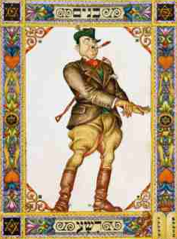
It is already 10:30 and my family is only up to The Four Sons story at the Passover Seder. My lucky nieces, having just sang The Four Questions, are dismissed to the kids’ table to eat their matzah ball soup, which I eye hungrily, hoping for a fracas — any excuse — to get out of here. To finally eat.
What was I thinking, going to Seder at my brother’s house? I know what I was thinking: I was thinking it would be nice to have a Seder with my family again. Sure, my father is married to a different woman – one who, unlike my divorced mother, wouldn’t ask her Fifth question: “If Passover is about ending slavery, why do the women have to work their asses off to prepare?” And my younger brother is also married, but he’s become an Ultra-Orthodox rabbi, moving as far to the right of our Modern Orthodox upbringing as I had moved left of it. But we are together again, me, my brother, and my middle sister, who, in her miniskirt and tights, is the only one of us who remained the same as we grew up, living in both the religious and Western worlds.
She convinced me to do the Seder with the fam, so here I am sitting next to congregants from my brother’s synagogue who are probably wishing they were at their ex-mother-in-law/boring boss/hairdresser’s house – anywhere but here, where every person in my family feels a God-given right to deliver commentary on every single sentence of the Passover Haggadah book.
That’s what I’m doing here: I remember my childhood Passovers being raucous and fun, as I played with my cousins and siblings under the table, stole food from the kitchen, and intermittently begged my father for clues to where the Afikoman matzah was hidden. I’d forgotten the part where I grew up and had to sit at the table, where the adults delved deeply into the same issues over and over and over again, postponing dinner until well after midnight.
Once again, I’ve confused feeling nostalgic with thinking I was missing out, thinking I could go back. I left the religious lifestyle late, at age 30, because my politics had changed, more than my theology. But now, ten years later, bereft of the comforts of community, of their certainty and sense of purpose, I sometimes return. I’ll go to a religious friend’s house for Shabbat, where my taste buds rejoice at the familiar taste of kugel and cholent, but am then shocked when one of the guests makes fun of, say, feminists. Or gays. Or liberals. Or the Arabs. And then I remember that at age 40, I’m different. I don’t belong.
I feel like I don’t really belong at this Seder, where my family is hotly debating the story of the Four Sons: The Smart Son, The Wicked Son, the Innocent One, and the One Who Doesn’t Know How to Ask. The “sons” represent different types of Jews. (No one, even my fundamentalist creationist family, thinks the sons are real.)
“But why is he wicked,” my sister is arguing. “What’s so wrong with him? Just because he isn’t doing what they want, should they call him evil?” she laments.
“He took himself out of the equation. That’s the worst thing you can do in Judaism,” my brother replies. He opens the Haggadah book and reads: “The Wicked Son says, ‘What is all this worship to you?’ He’s saying you!! Not us!! He’s not a part of it,” my brother bangs the table. “He’s an apikoress — an apostate,” he says, defining the word for the synagogue members, who were all looking in my direction.
Everyone, I think, is looking at me. I understand why my usually quiet sister (The Innocent One) is so interested in this debate. This debate about the Wicked Child is about me. I am their Wicked Child. And she, forever in the middle, is defending me.
Armed with years of religious education, I can defend myself. “I think the Wicked Child is fascinating,” I say.
The guests, slumped and falling dangerously close to their wine glasses, perk up. My brother glances worriedly at them. In the last ten years of my non-Orthodoxy, my family has had to deal with my Democratic, liberal, feminist, Two-State Solution outbursts, although as of late we have a detente on politics and religion. But it is Passover. And they started.
“Don’t you think it’s interesting how the Wicked Child says, ‘What is this worship you all do?’”
My brother, afraid of what I might say, whom I might convert to my team, still must engage. “What’s your point, Amy?” he says, feigning patience.
I explain that the Wicked Child asks them all about the “worship” they do, not the “faith” they have. “The Wicked Child doesn’t have a problem with their belief system, with their believing in God. He just has a problem with how they go about it,” I am standing now, like a rabbi. “The Wicked Child thinks they’re like pointless busy bees, running around moving piles of dust with all their arcane laws. That’s why they call him Wicked. They are afraid if others understand the pointlessness of the laws, there will be a revolution.”
The guests were trying not to smile. My brother was not. My father was not.
My younger sister, God bless her soul, says, “Well, I don’t think you’re the Wicked Child.”
My brother, remembering his filial duties, agrees. “She’s not the Wicked Child. She’s the One Who Doesn’t Know How To Ask.”
I smiled in triumph and then realized this is the biggest insult of them all. The One Who Doesn’t Know How To Ask is not Good or Wicked or even Innocent, just someone who understands nothing. That’s what my brother thinks of me, that I just don’t understand Judaism properly. That I don’t see how beautiful it is. That’s how we have maintained the peace between our differing lifestyles. “She is not evil,” they think. “Only misinformed.”
Just a few weeks ago I was upset that my five-year-old niece had to wear a uniform to school, long-sleeve shirts, long skirts and knee socks, even in 90 degree weather. “Some people enjoy tznius,” my brother said about the modesty laws. It’s true, his wife enjoys wearing a wig and keeping her elbows, knees and collarbone covered, in her long flowing skirts and stockings. He believes that if I only could understand the laws of modesty properly, I would be like them. If only he could explain it all, to me, to the guests and his synagogue members which he is trying to show the way.
He has a chance, to show them the way. I see it and feel it every time I am there, like at this Seder. His family is so lovely, his wife so gentle and kind, his kids so happy and joyous. For the opening blessing on the wine they danced in a circle, and were as excited as I had been as a kid for the hidden matzah hunt. They don’t have a TV and there’s no clamoring for endless cartoon-character themed toys because they’ve never even seen a movie! It’s all so tempting, it tempts me, every time I am there. The promise of peace in such a sheltered life.
“You just don’t have a religious personality,” my sister-in-law, the rebbetzin, once said to me. It’s true. I chafed at all the rules, the rigidity, the lack of poetry and freedom (speaking of Passover.)
And also, the price of this country-club living – shutting out everyone who is not like you — it’s like vacationing in the glamorous resorts of Jamaica surrounded by slums. The gated community is lovely if you don’t think about the people who are locked out. Those people, the downtrodden minorities, are the ones who I want to champion for. That is my Judaism.
“I’m not the Son Who Doesn’t Know How to Ask,” I say and everyone looks at me. I was raised a God-fearing, Kosher-eating, Shabbat-keeping, Israel-worshipping religious Jew, and now I am a liberal, secular, spiritual artist, so I understand the world from both sides. I am one of the few people in the religious-secular wars who can see the beauty of the religion and the sensibility of secularism. Outwardly, I have made my choice, cast my lot in with the rest of the world, but inwardly, I’m not always so sure. But I would never tell my family this. They would try to bring me back into the fold. But it would all end the same way, with me leaving, again and again, till the end of time.
Maybe this is why my father – who knows better than to incite me in this fight – thinks I’m the Wicked Child: I have the education, the upbringing, the experience, and still I do not worship their way.
“I am not any of the Four Sons,” I declare.
“You’re not a Son!” my five-year-old niece laughs.
“I don’t fit into any of these categories,” I add. Not having a label – Orthodox, Conservative, Reform, Secular – always confuses people. It makes them angry when they can’t fit you into a box. But being a lapsed Orthodox Jew is like being a former rock star – you don’t ever lose your past, and you sometimes long for old times.
It’s already 11 pm, and I hear my stomach growl from hunger, from the tension, from coming to a debate I don’t want to have anymore. The guests are looking to me, my brother, my father, my sister, for someone to settle this for them.
“Hey, can we move on now to the Ten Plagues or something more upbeat?” I joke. “We can always go back to this topic tomorrow night.”
Amy Klein is a freelance writer. Her work can be found at www.KleinsLines.com

Way to totally school your siblings with secular magic. A+
[…] came across an article in the Heeb Magazine titled “The Wicked Child” by Amy Klein and felt the need to share […]
You’re not rebelling against orthodoxy; you’re rebelling against the dysfunctional version that was passed down to you that parades itself as true orthodoxy; one whose criterion lauds ritual observance as the predominant feature over treating humans with kindness and respect. A truly religious person knows how to be kind to many, different than themselves.
Just because someone posts a shackle outside their kosher eating door ‘orthodox’ does not mean they are doing the real deal…no more than someone with a home gym who bench presses is called a true body builder. In fact, they may be doing it all wrong. And there are sadly enough today who call themselves orthodox because they keep some basic rituals–such as the sabbath, kashrut, etc. yet who miss the forest for the trees, or hurt others inappropriately, under the guise of ‘law’/’ritual’/ etc.
Is someone observant if they keep those laws, yet gossip or speak negatively, malign others? What about if they make people feel bad, or hurt others feelings? Or even subtler: manipulate people, or play mind games. Are you still orthodox, as long as you: keep kosher/keep sabbath/etc etc etc?
Does God consider this orthodox?
Actually, if you study the good book, those who keep rituals yet don’t treat humans (sometimes even their own) with kindness and sensitivity, are a disgrace to G-d. Some are even called a desecration to the Divine name (situation dependent) If you read the prophets, they often deliver the message that such ‘sacrifices’ are spurned by G-d. God wants compassion and kindness–in the right, appropriate places, first and foremost. (There are cases where compassion is not in place–different conversation.)
It is widely known that it says Derech eretz kadma laTorah (Chapters of the Fathers), and being a kind, healthy human being comes before any observance. If step zero’s skipped, the edifice-no matter how grand- lacks the proper foundation and cannot hold up.
One with a true foundation is strong, solid, and compassionate- which is not a contradiction.
But the very worst thing is those who’ve passed it down inaccurately think they’ve got it right-that they are really orthodox. And so do you. You accept their fragmented, or even dysfunctional version as an authentic version of orthodox when it is laced with very subtle holes, pernicious, destructive. Who says they are the real deal? Who says you are rejecting the real deal?
Since they think they’ve got it right, they don’t realize they need to revamp their whole edifice from it’s fundamental foundation. And because you think it’s right, you will be busy rejecting something that’s a distortion–parading itself as the real deal. Because it looks and seems like the real deal, you cannot tell that it’s distorted–or where the distortions lie, or how distorted it truly is. You haven’t tested their version sufficiently against it’s own texts and system. Guaranteed, it’s a different version.
Like a distorted mirror in an amusement park, it reflects the colors you don, so you think it’s you…but then…it’s wider than you are, or taller…it’s off. What if it’s just a bit off…so you think it’s accurate? That’s the worst-a mirror that tells you you’re ten pounds thinner…because you don’t even know it’s distorted till you can’t zip up. It’s the subtle distortions that can be the most destructive.
As is commonly known, change can only happen if you first admit there is a problem.
Those who think they have it right but have a distorted version cannot begin to correct it. They are the saint, and you are the sinner; they are in, you are out. This is not jewish.
Rabbi Abraham Isaac Kuk says aetheism comes to cleanse a person, or generation, of the wrong understanding of God.
In the ideal version, the men prepare just as much as the women–or they take everyone to a hotel so no one gets the brunt. Creating a family passover vision is a joint effort.
Regarding insularity–those who insulate do it to maintain a purity of focus, not as luxury or elitism. In a more genteel external surrounding they would gladly be more open. Do their children really need to see Braatz to be well rounded healthy people, or watch Lady Gaga videos? When the world was a bit more benign, there was less insularity (minus the hassidic sects). It is only protective to create a state of consciousness that is more healthy and less fragmented. I don’t say it’s ideal, but that is more what it’s about. [Forgive me, in this your assessement came across as an external judgement not capturing the soul of the matter accurately.] Note that if you poke around in today’s secular society there are many who also have chosen levels of insulation for their children –monitoring exposure to television (some don’t even have), social media at varying ages, etc.
Not all versions of orthodoxy advocate this model–definitely not in its root. Studying the writings of those such as Rav Hirsch; Rav Soloveitchik and many others—they all recognize the value the greater world has to offer and talk about the balance and blend of orthodoxy without syphoning off everything else…like any balanced diet, it must be engaged with intelligence. (How that would translate practically speaking to our times- something else.)
It is well known that everyone has all the four sons within them, to different degrees. Some are mostly the wise one, but has a little wicked one in them. Some mostly the reverse. Acknowledging that we are all growing, all imperfect but striving to being better, is where it’s at.
It sounds like the solution for you and those who attempted to pass it down to you (-or as religious version goes, teshuva)–is to go back to step zero and fix the derech eretz part. It sounds like its what you’re aiming at.
Kindness begins in the home and goes outward, in its balanced version. Being kind, compassionate, and humble-in thought, speech and deed, is the foundation on which every human is built in a healthy way.
You must be healthy before you can be holy. It is true whether you decide to be ‘religious’ or ‘not’.
What makes someone qualify as ‘wise’ or ‘wicked’? Is wicked one who asks questions? Or one who acts like a jerk?
Sometimes people mask their ‘unhealthy’ by having an impressive ‘orthodox’–or other (-wealthy, prestigious, fashionable, intimidating) structure, but their true hearts need a lot of work. And, quoting Samuel: Man sees into the eyes, but G-d sees into the heart.
The heart-and the actions that flow out of it–is not a replacement for ritual: It is the essence and the goal of it–to create a self and a world that is positive, peace loving, balanced, whole, proactive.
So in regard to this story, it is the ‘either’ ‘or’ that is a faulty model. What if it’s neither? What if you just met a couple of bad salesman who worked with a flawed manual and passed down a defective or flawed version…one that sounds like the real deal…but…borrowed a few trappings and isn’t…
IN response to Joe’s response: I think you’re missing the boat here. It’s not about maligning Orthodoxy. There are plenty of Orthodox Jews who do it right – who are compassionate and treat others kindly, even of other walks of life. Orthodoxy, however, IS about separation – You see it everywhere – Kosher laws are “l’havdil bein ha’amim” (to separate between the nations) you can’t get a tattoo only because one group of goyim did that back in the day, etc…Most of the Orthodox world abides by that rule of thumb.
My take on it is that, just like there are 4 sons that represent the 4 types of “geula” or “freedoms”, but there is ultimately a fifth, just like there is a fifth kind of freedom the Haggaddah alludes to, but never mentions (after all, isn;t that the purpose of the seder?) and therefore, a fifth kind of “son” that being someone like the Amy, who rises above petty differences, can be IN the world, without Havdala, and yet appreciate fully what G-d wanted, and wants from all of us – to be mindful of his presence and treat others with lovingkindness, regardless of whether they are the same as us.
Jay is right. Orthodoxy is about separation, and that’s why so many Jews are turned off.
Heeb is weak
WOW. Very impressive!
You’re an invited guest.
Start a confrontation in front of other guests and children, then when it’s their turn to answer turn it off and say let’s eat.
Insensitive coward.
If you want to debate with gloves off, if you really wanted an answer to your issues, ask someone who isn’t terrified of losing you forever when they answer you.
It is only their love and hope you’ll return that has them inviting you to their table each year.
Ask or debate in a forum where the replies may not be so timid or sensitive to your feelings, and then see where they are really at, instead of taunting them in front of the kids as a reward for having you over out of love.
If your relatives don’t have a stroke controlling the words that they want to cut loose, I am sure they will be rewarded for keeping their mouths shut.
Go get real answers. Talk to a real qulaified kiruv professional.
And while you’re at it, go visit those friendly Arabs, or the slaves they married from Jewish homes and then talk about vitriol against Arabs and a two state solution. Or visit Hadassah hospital when they treat Arabs who were hurt while their brothers were throwing firebombs at civilian Israelis and the Arab mother soothes the child, “shh..shhh.. don’t worry, one day you will kill that Jewsih nurse who gave you a needle for tetanus.” So open minded your brains fell out.
Visit there. Then testify.
Until then you’re an ivory tower blathering idiot.